
Commercial Solar Peak Shaving in Bangladesh: Demand Charges, Battery Sizing & Worked Example
Direct answer: Peak shaving is the practice of using a battery to cap a factory or commercial building's grid demand at a set kW limit, so a short spike in load never becomes the month's billed maximum demand. Commercial and industrial bills charge not only for total energy (kWh) but also for the highest demand (kW or kVA) recorded in a billing interval, so one 15-minute spike can raise the demand portion of the bill for the whole month. A battery that discharges exactly when load crosses the cap flattens that spike, while rooftop solar cuts daytime energy use and charges the battery for the evening peak.
Two charges on every C&I bill: kWh and kW
Most factory owners read only the total on their electricity bill, but the bill is really two bills in one. The energy charge pays for every kilowatt-hour consumed. The demand charge pays for the rate at which power was drawn at its worst moment — the highest kW or kVA averaged over a billing interval, typically 15 or 30 minutes. A site that uses 100,000 kWh evenly through the month and a site that uses the same 100,000 kWh with one sharp afternoon spike can pay very different demand charges, even though their energy consumption is identical.
This distinction is what makes peak shaving a billing-control strategy, not just an energy strategy. Solar panels alone reduce kWh, which is valuable, but they do not by themselves control the kW peak — especially an evening peak that arrives after sunset. A battery is the tool that controls kW, because it can deliver power within seconds, precisely when the meter would otherwise record a new maximum.
Why Bangladesh factories are good peak-shaving candidates
Three features of the Bangladeshi commercial and industrial load make peak shaving unusually relevant here. First, time-of-use pricing creates a real spread: under the June 2026 BERC tariff order, LT commercial and office connections pay a flat 15.36 taka per unit, with off-peak at 13.82 taka and peak at 18.43 taka per unit, as set out in our commercial rooftop solar ROI guide. Energy moved from off-peak or solar hours into peak hours is therefore worth more per unit. Second, factory loads are spiky by nature: chillers, compressors, welding lines and large motors starting together can lift demand by hundreds of kilowatts for minutes at a time. Third, the evening load peak in Bangladesh falls after solar production ends, so solar without storage cannot touch it — the battery is what carries midday solar into the evening.
The practical consequence is that a factory should be sized and sold on its load profile, not on its roof area. Two factories with identical 200 kW rooftop arrays can have completely different peak-shaving value, depending on whether their peaks are sharp and predictable or flat and constant. A flat load has little to shave; a spiky load has a great deal.
How a peak-shaving battery actually works
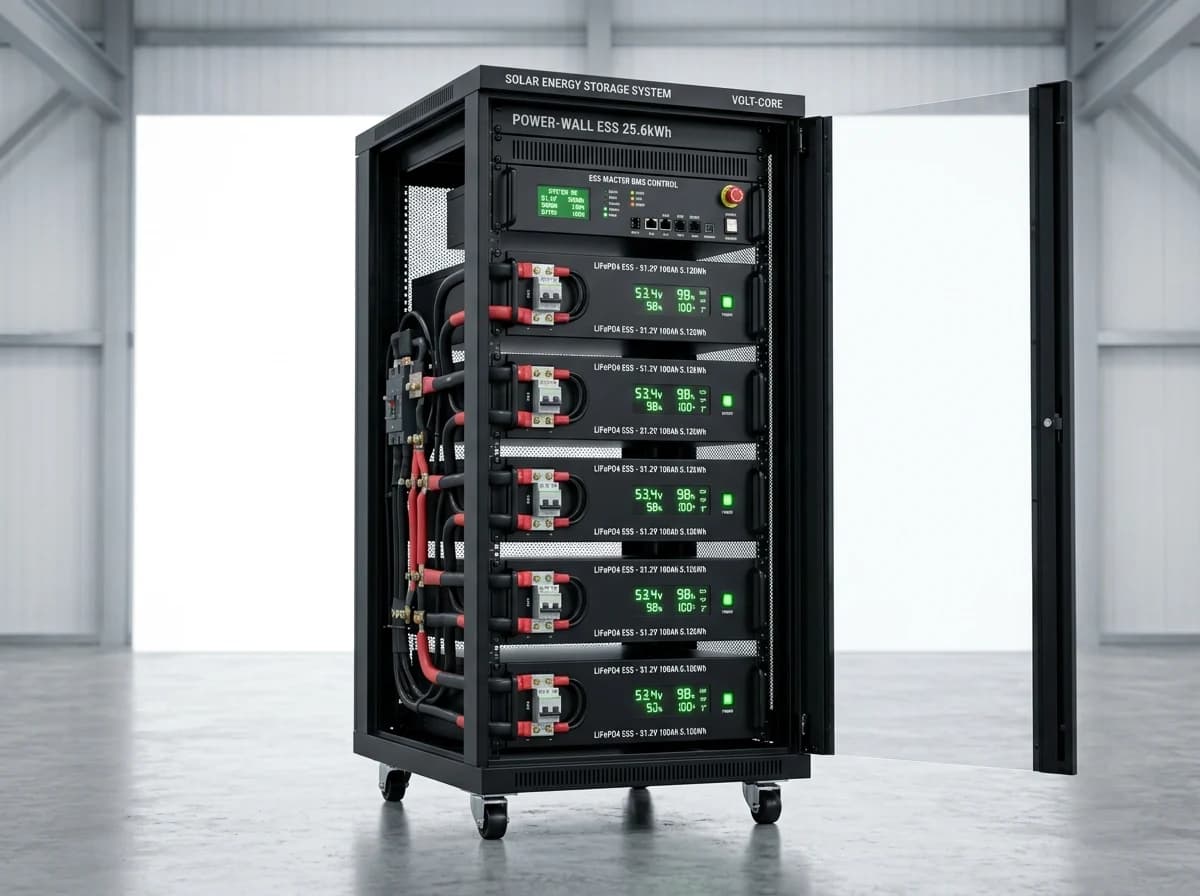
A peak-shaving system has four parts: the battery, a bidirectional inverter, a meter or current transformer watching grid import in real time, and an energy management system (EMS) that decides when to discharge. The logic is simple to state and demanding to execute:
- Set a demand cap. From 12 months of interval data (or at least a full representative month), the EMS sets a target grid import — say 750 kW for a site whose natural peak is 900 kW.
- Watch in real time. The controller samples load every few seconds and forecasts where the current billing interval will end.
- Discharge only above the cap. When forecast grid import crosses the cap, the battery supplies the difference. Below the cap, the battery rests or recharges from solar.
- Protect the reserve. The EMS holds enough state of charge for the expected peak window and never empties the battery on a minor fluctuation — a false discharge early in the day leaves nothing for the real peak in the evening.
Sizing follows directly from the cap. Shaving 150 kW for a 30-minute peak needs at least 75 kWh of usable energy for that single event, before round-trip losses and a safety reserve — in practice, roughly 100 kWh of usable capacity. For a one-hour plateau, the same 150 kW shave needs about 150 kWh usable. Industry sizing guidance puts battery inverter power at roughly 10–40% of facility peak demand for peak-shaving duty, and duration at 0.5–1.5 hours depending on whether peaks are spikes or plateaus. Short, sharp peaks are the cheapest to shave; long, flat peaks are the most expensive, because they need energy, not just power.
Solar + storage: the combination that covers both charges
Solar and batteries attack different parts of the bill, which is why the combination outperforms either alone:
- Solar cuts kWh. Every self-consumed solar unit avoids a grid unit at the full retail tariff, as our ROI guide shows with a 100 kW worked example.
- Solar charges the battery for free. Midday surplus that would otherwise be exported at the lower settlement rate (currently 10.50 taka per unit on a quarterly basis, per the same guide) can instead be stored and discharged during the peak window, where it is worth the peak tariff — or, more importantly, where it prevents a new demand record.
- The battery cuts kW. It clips the demand peak that solar cannot reach, including the evening peak after sunset.
- The battery adds resilience. The same stored energy that shaves peaks can ride through a brief outage for critical loads, replacing part of the diesel-generator duty that many factories still carry.
A common mistake is to size the battery from the solar array (for example, one hour of array output) instead of from the load profile. The correct order is reversed: first measure the peaks, then size the battery to the peaks, then check that the solar array can recharge it. A battery sized to the array but not to the load will run out halfway through the peak window — the most expensive possible failure, because the peak it missed still sets the month's demand charge.
Worked example: a 300 kW factory in Gazipur
Consider a garment-accessories factory with a natural peak of 300 kW, a daytime base load of 180 kW, and a sharp 45-minute evening production peak. The proposal sets a demand cap of 240 kW:
- Shave required: 300 − 240 = 60 kW.
- Energy per event: 60 kW × 0.75 hours = 45 kWh usable.
- With losses and reserve: at about 85% round-trip efficiency plus a 20% reserve margin, the battery needs roughly 65–70 kWh of usable capacity — a 70 kWh-class system, not a 200 kWh one.
- Solar charging: a 100 kW rooftop array producing around 1,400 kWh per kWp per year in Dhaka conditions generates roughly 380 kWh on a good day, far more than the 65–70 kWh the battery needs — so the battery recharges from solar surplus alone on most days, without grid charging.
- Arbitrage bonus: if that 65 kWh is discharged during peak hours instead of bought at the 18.43 taka peak rate, and was charged from solar surplus that would otherwise have exported at 10.50 taka, the daily energy value is roughly 65 × (18.43 − 10.50) ≈ 515 taka — a secondary benefit. The primary benefit is the demand-charge reduction, which depends on the site's own demand tariff and is usually larger than the arbitrage value.
The lesson of the example is proportion: the battery is small relative to both the factory load and the solar array, because it only needs to cover the peak, not the whole load. Oversizing it to cover hours of full load destroys the payback; undersizing it to a token capacity misses the peak entirely. The interval data decides.
What can go wrong: four failure modes
- Missed peaks. A cap set from monthly totals instead of interval data, or an EMS that reacts too slowly, lets the spike through. The battery then looks like an expensive ornament. Always demand a design based on 15-minute interval data.
- Early depletion. Discharging on every minor fluctuation empties the battery before the real peak. A good EMS uses forecasting and a state-of-charge reserve, not a simple threshold.
- Battery cycling wear. Peak shaving uses shallow, frequent cycles. Lithium iron phosphate (LiFePO4) chemistry, with its high cycle life, suits this duty far better than chemistries optimised for deep daily cycling — confirm the warranty counts shallow cycles the way the application actually uses them.
- Ignoring the rest of the plant. A battery cannot fix a plant whose strings are shaded, soiled or badly grouped. Shading losses alone can cut string output far more than the shaded area suggests, as our shading analysis guide explains, and a plant that under-produces cannot recharge its battery. Fix the array first, then shave the peak.
What to demand in a peak-shaving proposal
- 12 months of interval load data (or a full metering study) with the peaks identified by time of day and cause.
- A stated demand cap and the kW shaved, with the battery's usable kWh derived from that cap and the peak duration — not from the array size.
- A round-trip efficiency figure and a cycle-life warranty matched to shallow peak-shaving cycles.
- Confirmation of how the battery recharges (solar surplus first, grid only if the tariff allows it) and what happens during a grid outage.
- A handover test: a recorded peak event showing grid import held at the cap while the battery discharged, verified against the same per-string and performance checks in our commissioning checklist.
If a vendor quotes a battery by kWh alone, without a demand cap and interval data behind it, they have not designed a peak-shaving system — they have sold a box.
FAQs
Does peak shaving work without solar panels?
Yes, but it earns less. A battery charged from off-peak grid power can still shave peaks and capture the peak/off-peak price spread, but the spread in Bangladesh (13.82 taka off-peak versus 18.43 taka peak for LT commercial connections) is modest once round-trip losses are counted. Solar charging is what makes the economics strong, because the charging energy is surplus that would otherwise export cheaply.
Will a battery eliminate my demand charge?
No — it reduces it. The cap is set below the natural peak but above the base load, so some demand charge remains. A proposal promising zero demand charge is either oversized to absurdity or misunderstands the tariff. Judge proposals by the kW shaved and the payback on that shave, not by slogans.
How long does a peak-shaving battery last?
LiFePO4 systems used for shallow peak-shaving cycles commonly carry warranties of 10 years or around 6,000 cycles, but the real life depends on depth of discharge, temperature and how often it cycles. In Bangladesh's heat, the battery room's ventilation and cooling matter as much as the cell chemistry — a battery cooked at 40°C ages faster whatever its datasheet says.
Is peak shaving worth it for a small factory with a flat load?
Usually not as a standalone investment. If the load is flat, there is no spike to shave, and the battery's only value is arbitrage and backup. In that case, invest in solar first for the kWh saving, and add storage only if backup or diesel replacement justifies it on its own.
Should the battery discharge every day?
Not necessarily. On days without a peak event, the battery should rest at a healthy state of charge rather than cycle for a tiny arbitrage gain. Every cycle costs a little life; the EMS should spend cycles where they earn the most — on the peaks that set the bill.
Sources: BERC June 2026 tariff order figures (LT commercial flat 15.36, off-peak 13.82, peak 18.43 taka per unit; net-metering export settlement 10.50 taka per unit) as reported in Noor Solar's ROI guide; peak-shaving sizing practice (battery inverter 10–40% of facility peak, 0.5–1.5 hours duration, 15/30-minute demand intervals) from commercial storage sizing literature; Dhaka specific yield ~1,400 kWh/kWp/year and performance-ratio context from the ROI guide's cited PVsyst study.
Need Commercial Equipment for Your Project?
Get manufacturer-direct wholesale pricing, complete compliance documentation, and Dhaka warehouse delivery lead times.